
The honeymoon is over, so everyone in retail media says. The easy money is gone. What they’re referring to, of course, is that onsite sponsored products, the first lever most retailers pull, is running out of juice. A lot of those platforms are at saturation point.
So the leaders tasked with growing this lucrative media business are looking for the next thing. The next pot of gold. Is that offsite audience extension? Is that putting digital screens in stores?
Those are all viable, but there are trade-offs. They’re either low margin, expensive and time-consuming to deploy, require a dedicated and expensive sales team to bring in advertiser demand, or a combo of all three.
But there’s a new idea out there that’s potentially a win-win for the advertiser and the CMN, and also a win for the customer. It’s called Nift, and the biggest barrier to RMNs adopting it, according to Nift CEO Elery Pfeffer, is that it sounds too good to be true.
This isn’t the first time I’ve had nice things to say about Nift. I wrote about the company a year ago in a column for The Drum on ways retailers could reduce their reliance on onsite search ads. Since then I have argued that we need models for the future that won’t be disrupted by AI agents pulling the customer journey forward a few steps. Nift-style placements sit in moments AI shopping agents are unlikely to disrupt, and gifts tied to reviews and experiences create the kind of genuine customer content AI models look for when recommending products.
An important disclaimer: this edition of Retail Media Breakfast Club was commissioned by Nift to provide an independent assessment of its commerce media offering. Nift engaged me knowing I’d be including my usual spicy take and seeking anonymous feedback from the RMN community. That’s why this bonus edition is called ‘Pressure Test’.
One more piece of context. Nift works across commerce media well beyond retail: payment apps, fitness brands, travel and more. But this is the Retail Media Breakfast Club, so I’m asking the question I was brought in to answer: where, when and how does this make sense for an RMN, and where doesn’t it?
This article is also available as a multi-media video on YouTube:
What is a Nift?
Nift operates a marketplace of brands (advertiser demand) and partners (retailers and other commerce businesses).
Brands want to reach net-new customers, and they're prepared to pay for them by offering an incentive, a gift, to get people to try them out.
Retailers want to generate ad revenue, but not in a way that disrupts their existing ad partnerships, their organic sales conversions, their loyalty program, or the customer experience.
Nift allows brands to create gifts that are offered as surprise and delight experiences at different points in the customer journey: a birthday, checking in at a location, leaving a review. As Nift CEO Elery Pfeffer told me: "You're never gonna give your customer a happy birthday ad… But you would give a gift."
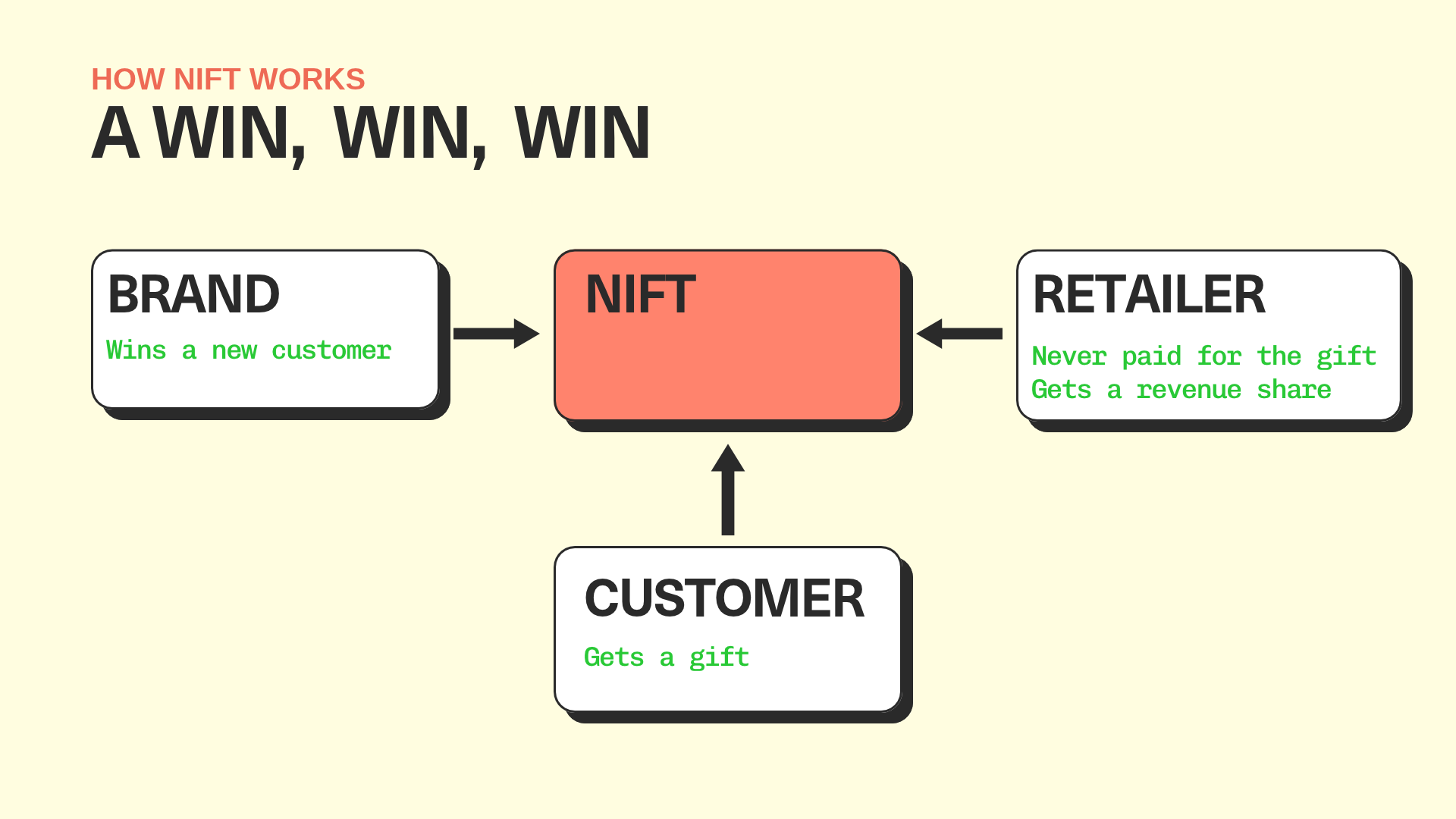
The brand wins because they got a new customer. The customer wins because they just got a gift. And the retailer wins because they never paid for the gift that made the customer happy, AND they get a split of the ad dollars the brand paid to be there.
Saket Mehta, Nift’s chief revenue officer, used to sit on the other side of the table, running advertising partnerships and revenue at Block. “What I’ve always wanted, being on the other side and owning revenue goals at a commerce media company, is how do I make the ad not feel like an ad?”
Consumers love it
One retailer I spoke with raised customer experience as a concern: could this be a negative for their customers? After looking into it, I don't think so. End customers, by and large, seem to really love it.
Most consumers say they hate ads. Sure, there's a good argument that they only dislike disruptive, irrelevant ads, and the relevant ones can be quite good. (Source: my bathroom cabinet bursting with late-night purchases made on Instagram.)
But a gift is different, especially when it arrives as a surprise rather than a reward. As Lauren LeDonne, Nift’s director of client success and growth, told me, a gift occupies another part of your brain. If you’re offered 10% off at a restaurant, you’ll think and spend differently than if you’re offered a $30 credit to try a new restaurant. One is a gift, the other is an obligation to spend.
Planet Fitness, a current Nift partner, is very deliberate about this. As Justin Unger, who leads partnerships and ecommerce at Planet Fitness, told me: "We don't want to be directing [our members] or giving kind of our stamp of approval on a partner experience that is less than ideal. And so we're very mindful of: are our members still actually redeeming the gifts when they do enter that experience? And the answer is yes."
Foot Locker sees the same thing after a purchase. Speaking at a Nift session at Cannes this year, Lora Loesch, Foot Locker’s head of media, said: “90% of customers that get a Nift gift say they love the experience… and they want to come back to Foot Locker again.”
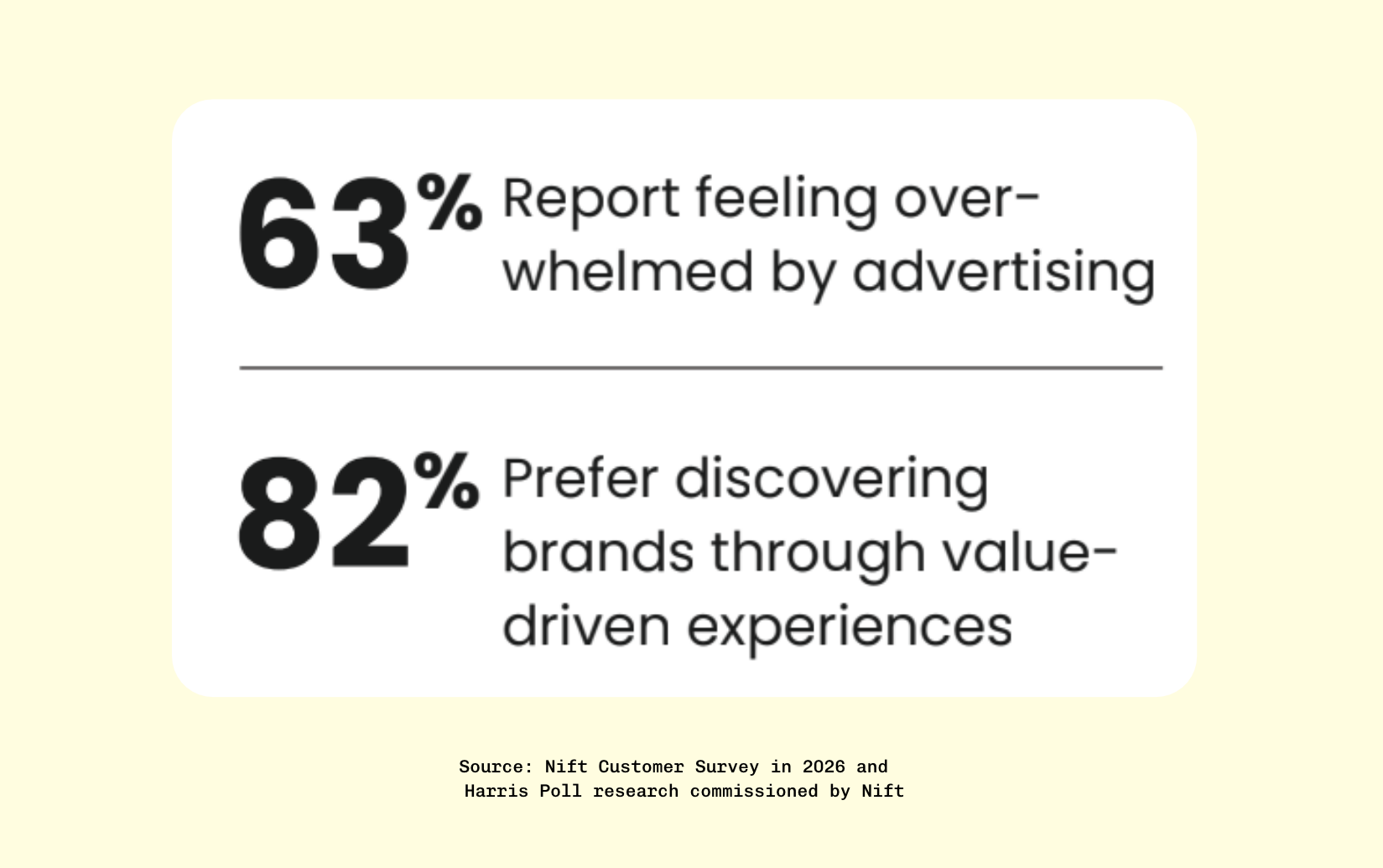
In Nift’s Spring 2026 survey of more than 3,100 consumers, 82% said this way of discovering new brands is better than ads, search or social. And the experience rates 4.8 on Trustpilot.
The reviews do have one recurring complaint: gifts with a minimum spend, which make a “gift” feel more like a coupon. Brands often push back on big discounts, but Nift holds the line at a minimum of 50% off. Its matching also gives more exposure to the gifts people actually choose and use, and partners approve which brands and offers appear.
For a partner, the experience is only as good as the gifts on offer. A high bar protects it, but it could also mean fewer offers and less revenue. That’s a trade-off each partner will have to weigh.
Bringing in demand
One of the biggest advantages for the partner side is that Nift brings in net-new, non-endemic advertiser demand. Retailers don't need to go out and "sell" this to their existing advertisers; Nift already has the demand coming in. My read is that there's more demand from advertisers than supply from platforms. Which might be a problem for Nift, but is actually kind of great for retailers and commerce media networks.
One department store retailer I spoke with couldn’t picture what Nift could offer that wouldn’t compete with its own range. Partners choose which categories and brands appear, from more than 14,500, and can block competitors. But Nift says about 56% of its October US advertiser spend came from physical products. For a specialty retailer, that still leaves plenty to choose from. For one that sells almost everything, the block list does a lot of work.
Where it gets confusing
If this sounds familiar, that’s because Nift looks a bit like several things RMNs already know.
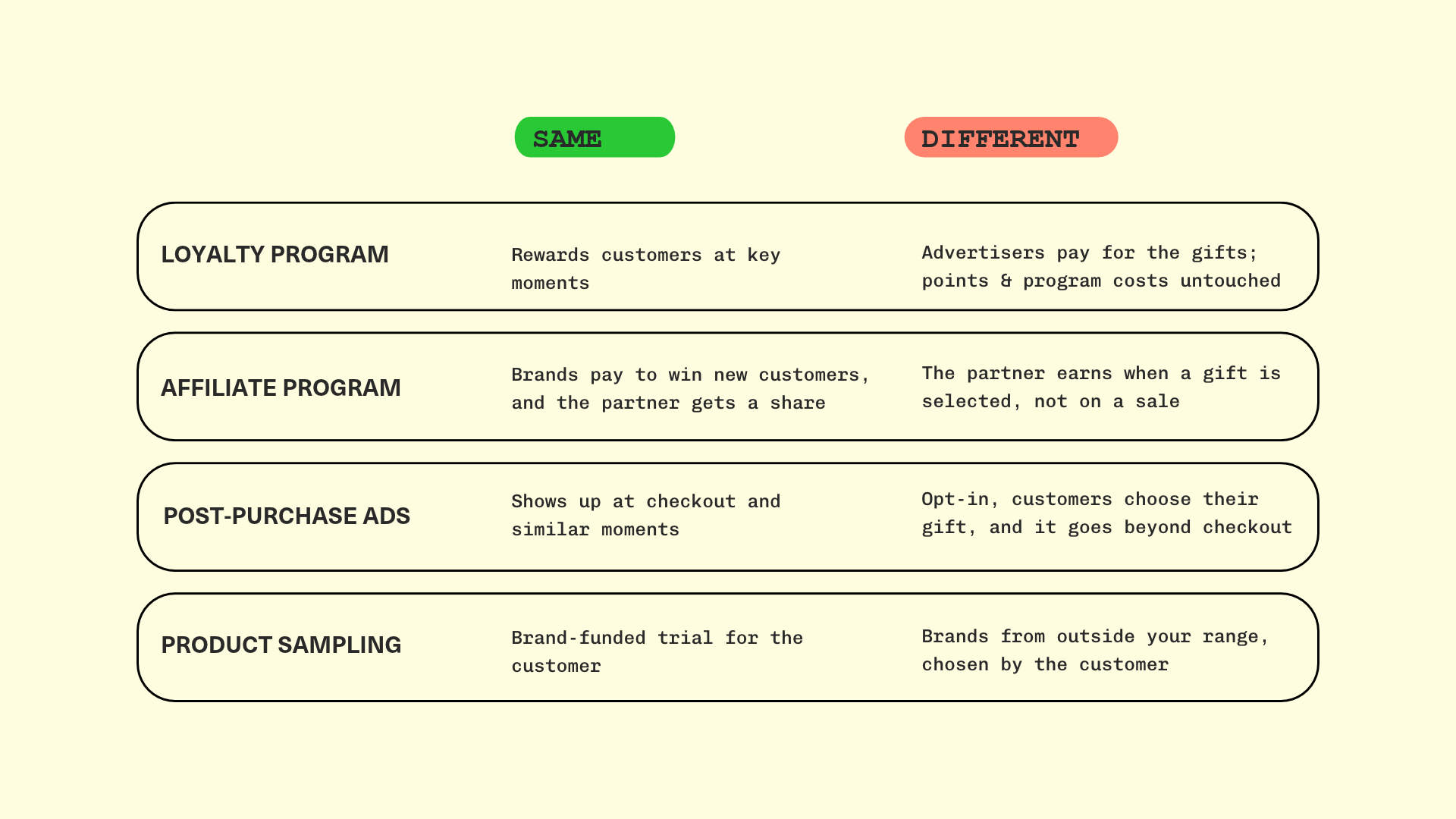
This is Nift’s blessing and its curse: it’s a new category of media offering, with some relation to all of these things, so there’s a ton of education to do to clear up exactly what it is and isn’t.
Planet Fitness runs its own affiliate network too, and Justin told me: "We haven't seen any overlap yet. I think it's complementary right now."
What's the catch?
So why are RMNs sleeping on Nift? "It sounds too good to be true" is the answer that Nift CEO Elery Pfeffer gave me, which sounds like a pat answer, though knowing how furtive many retailers are, it could be true. Here's what I see as the real issues, including POVs from a few retailers I spoke with on background.
1. Control
This is the flip side of the “done for you, plug and play, we’ll bring the demand” coin. The partner doesn’t control the sales motion or some aspects of the experience, and plug and play only allows so much customization.
Partners do decide which brands and categories appear, can exclude competitors, and choose where the experience shows up. What they don’t control is which brands Nift signs and what offers those brands make.
That also means relying on Nift to run a thriving marketplace. If Nift doesn’t do a great job of selling to brands, that ad revenue dries up. You don’t spend time or money drumming up demand, but you can’t control or influence it either.
2. The size of the prize
By my rough math, a retailer with 5 million purchase confirmations a month could expect something like $2–3 million a year from a single placement. Nift calls that a fair, conservative estimate. That’s real money at close to full margin. But next to growing onsite sponsored products, activating marketplace sellers or inking big offsite partnership deals, it’s an incremental line more than a foundation.
Nift agrees that for the biggest networks, onsite search “will always be the core engine.” Elery told me partners get “higher CPMs than they would with ads.”
The number also grows as partners add moments. Nift says one health and fitness app grew its Nift revenue five times over in a year by adding an in-app milestone, an SDK placement (Nift built into the app itself) and messages to lapsed users. Channel matters too: in Nift’s top-performing placements, SMS and in-app earned roughly twice the revenue per thousand of email.
3. It’s new and different
Sadly, this is where we’re at in retail media right now. There’s a lot of playbook-following, which makes it harder for an RMN leader to get something that looks new and different over the line.
One retail media leader told me Nift didn’t give them an immediate hook. They compared it with a product sampling solution which they jumped on right away, because they could see both the value and the margin story they’d need to sell it internally.
Nift’s answer is that margin is where it’s strongest, and I think the economics back that up. When I asked how an RMN leader would actually build the business case, Nift gave me the formula:
Eligible customer moments × share of customers who activate × share who select a gift × price the brand pays × your revenue share
It’s a sound formula, but it’s a different kind of business case from the ones most RMN leaders are used to taking upstairs.
Where it fits, and where it doesn’t (yet)
Whether Nift makes sense for an RMN depends as much on how your organisation is set up as on the product itself.
Nift makes sense if:
- Your media and loyalty teams already work closely, or you run both. One retailer’s first reaction to Nift was “I’d need to get my loyalty team to review and approve this.” If loyalty is already at the table, that hurdle disappears. Nift says one global tech retailer runs it inside its “thanks for joining” email.
- You have customer moments that earn nothing today: delivery updates, birthdays, loyalty sign-ups. In Nift’s own survey, consumers said they’re most open to discovery around birthdays and anniversaries.
- You can reach customers by SMS or in-app. Nift says its top placements in those channels earn roughly twice the revenue per thousand of email.
- You want high-margin, non-endemic revenue without building a sales team, or you don’t have a media network at all yet. Nift says businesses without media networks are an important part of its business.
It’s not the right fit (yet) if:
- You need an initiative that carries this year’s growth target. A single placement is a seven-figure line, not a nine-figure one.
- Nobody can own something that sits between media, CRM and loyalty. As one retail media leader put it: “who owns this?” Nift’s advice is to start with one moment and one owner. If nobody will take it, it’ll stall.
- You need to own the advertiser relationship and the sales motion. With Nift, you won’t. (That’s kind of the point, though.)
- You sell almost everything. The more categories you have to block, the thinner the gift pool gets.
Will adding Nift change the trajectory of an established RMN next year? No.
Should many of them do it anyway? Yes. The product isn’t the hard part. Getting your own teams to agree on who owns it is.
What next
Nift CEO Elery summed up the bigger picture when I spoke with him: most retail media captures demand that already exists, and that demand is finite. As more networks reach the same shopper across more surfaces, efficiency goes down, and eventually operators have to get creative about how they monetise the customer relationship.
Novel approaches may offer commerce media networks a way out of what I’ve called the ‘doom loop’ – the vicious cycle where networks launch with sky-high profit expectations, grab some quick wins by repackaging trade dollars as ‘retail media’ then stall out when that easy money runs dry.
The honeymoon may be over for retail media. But it turns out a gift is still a pretty good way to start a new relationship.
Thank you to Nift for supporting Retail Media Breakfast Club and inviting me to share my candid view on their offering for RMNs. Nift contributed information for this piece, but all views are my own.
Learn more about Nift for retailers and commerce media networks.