
Today's post is a guest contribution from Tom Limongello, host of The Middlemen Podcast.
It got me thinking because I tend to focus on retail media networks in this newsletter. Retailers have unique needs and assets (as do other commerce players) and I feel like I can provide the most value in this category since I know it best. But I am curious about the broader commerce media ecosystem, and the 'better together' data story. As Tom explains in this piece, the ability to understand and address entire shopping missions is the real unifier here.
This piece was originally published to Tom's substack as Retail Media Isn’t a Cart. Commerce Media Can’t Mean Everything on July 30.
To tell you the truth, I was lowkenuinely (low-key, genuinely) going to just delete the segment Todd had on defining Commerce Media from the recent episode with Collin Colburn of the IAB. I was sitting there editing and I heard Todd say:
I think we'd say that United and the back of the screen or Delta's back of the chair screen is commerce media because…it's not their cart, but their retail media might be if I was showing ads in the checkout of the plane ticket.
I viscerally reacted to this comment. Why the fascination with the cart? My experience with retail media started with Offsite for retailers who hadn’t even fully committed to eCommerce. More to the point, Todd and I had just sat on the Kroger rooftop in Cannes with Christine Foster talking about how a consumer could be targeted on TikTok using the retailer’s audience, but that the cart is basically irrelevant on social for low priced products. Shipping a single can of Poppi because you discovered it on TikTok is absurd. Instead, you’ll discover on social and then buy in-store. In this case the ad exposure was on TikTok, but Kroger was the merchant of record.
Todd and I used to argue a lot, but it was usually because we were both trying to explain the differences between the retail and media worlds. So I kept thinking about what was behind his definition—and whether it could lead us to a better one.
What I think might have been missing from our discourse was a very specific retailer vocabulary word: assortment. A retailer’s assortment is the complete set of products it chooses to sell. Broader Commerce Media networks can create demand for products and services outside their own assortments.
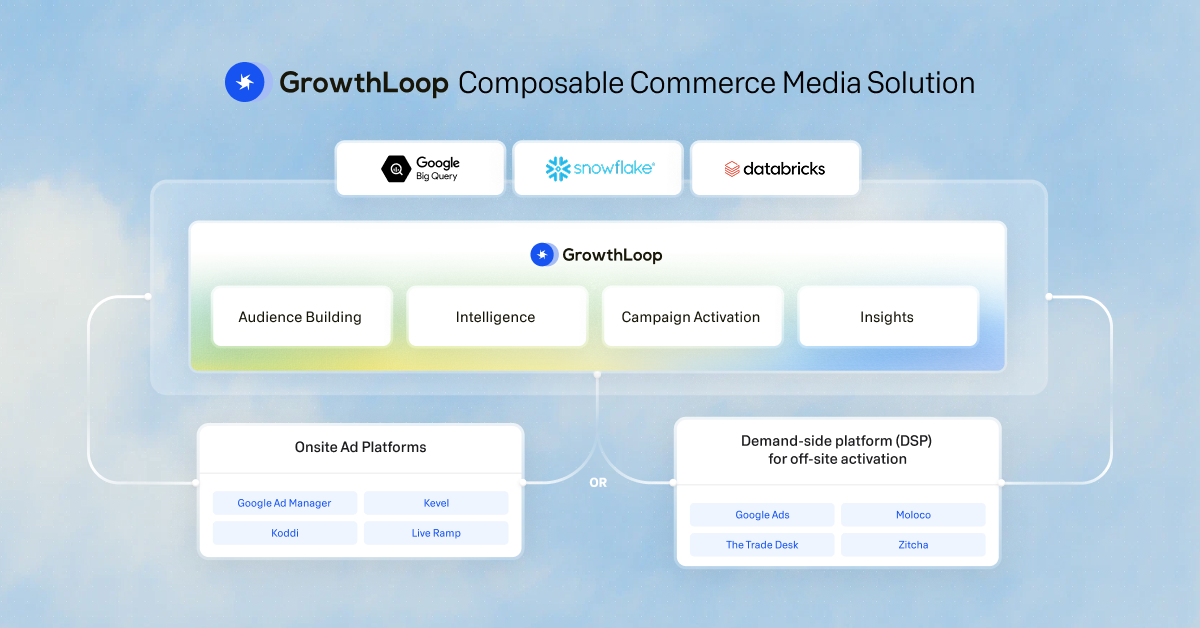
Are manual processes slowing down your RMN momentum?
With GrowthLoop’s composable commerce media solution, retail media and ad teams can build and launch precise audiences in minutes, activate across DSPs and ad platforms, and deliver transparent ROI reporting that drives advertiser revenue.
Learn how retail media leaders at Costco, Fanatics, and Gopuff use GrowthLoop to deliver stronger results for their brand partners.
A year ago, we had Harsh Jiandani on the podcast, and he gave us a simple definition of Commerce Media that was easy to remember:
“For me is Retail Media is SKUs and Commerce Media is everything that’s not SKUs. Period.”
In many Retail Media systems, the SKU is more than the final record of what someone purchased. It is the targeting language itself. Customers can become collections of product views, purchases and affinities that determine which products should be promoted to them next.
Harsh later in the episode explained why moving from keywords to SKUs was an operational advance. It gives the system greater precision about what is being advertised and ultimately purchased.
That makes the SKU a useful way to operate retail media, but not a definition of it. SKUs identify the products involved. Shopper missions explain what the person is trying to accomplish.
That distinction matters across Commerce Media. Every network is trying to understand a mission. What changes is whether it owns the advertised assortment. Retail Media networks are generally organized around the retailer’s assortment. Emerging Commerce Media networks can create demand for products and services outside their own assortments.
Travel is my favorite demonstration of why the shopper mission creates value even when the network doesn’t own the advertised assortment.
So when Todd talked about the airline seatback screen he was evaluating its function as a non-transactional surface, and which advertisers can fit. If you’ve heard Todd recently on the podcast he likes to think deeply about how ‘endemic’ the advertiser is to the retailer.
The seatback screen and hotel-room TV are not offsite media. They are owned and operated by the Commerce Media network. What the network may not own is the advertised offering. You’re not buying another airline ticket or hotel room. You’re deciding what else you want from the trip, often on impulse.
Impulse in grocery might mean grabbing M&M’s at checkout. Travel changes the scale. Once someone has paid for the flight and hotel, the impulse purchase might be a handbag, an expensive dinner or an excursion. Those purchases can feel justified because they help the traveler make the most of what they have already spent, and therefore…live the version of the trip they truly imagined.
In a recent two-part study conducted by BCG and commissioned by Kinective by United and Marriott Media, we see that travel purchases cover a whole range of categories. It would actually be inefficient for the Commerce Media network to ‘stock’ all of these SKUs and experiences.
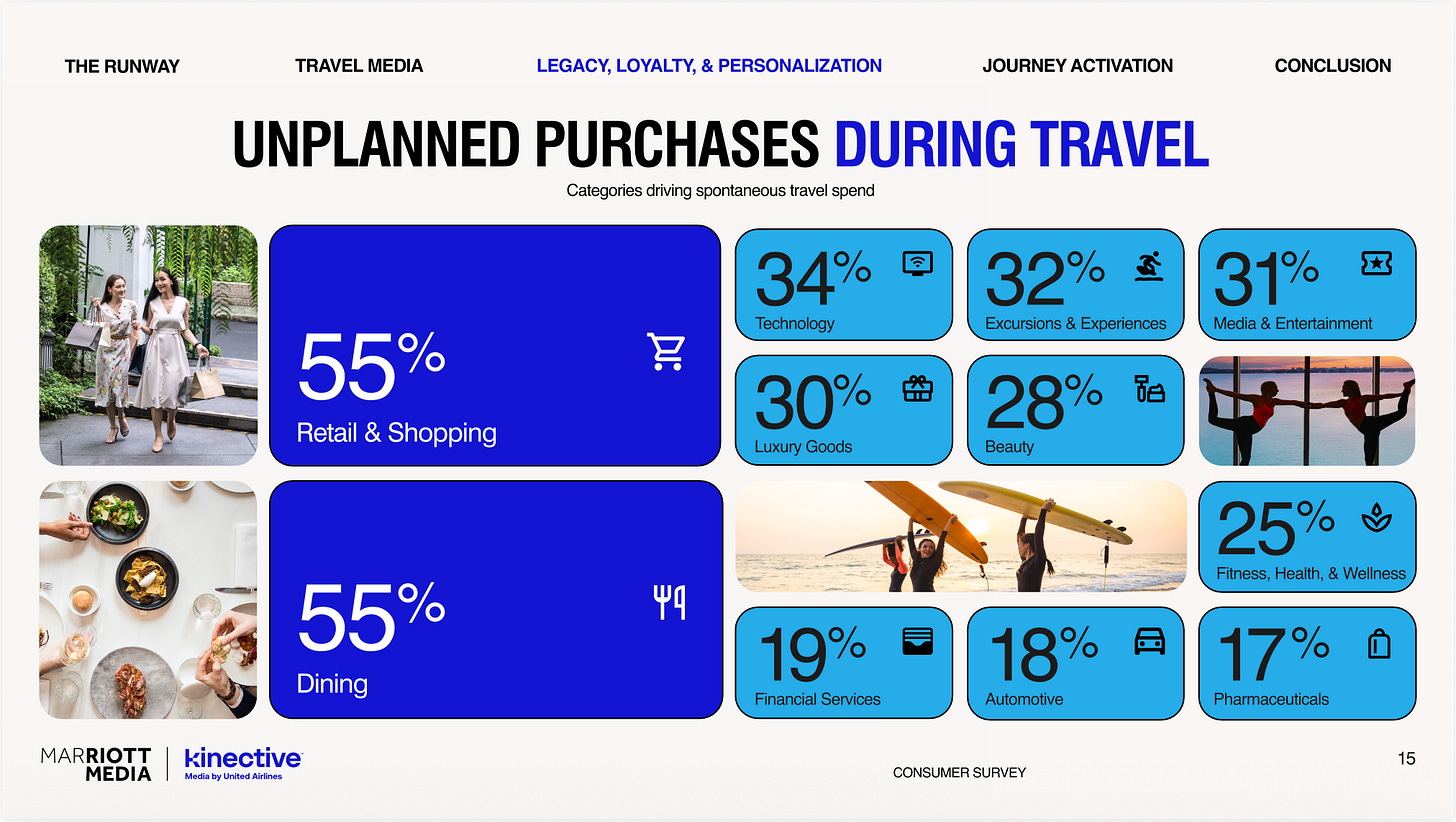
“Installment II: Tapping into the Psychology of Travel.” Consumer survey conducted by BCG, Powered by Marriott Bonvoy & United Airlines
Not owning the assortment is part of what makes these Commerce Media networks interesting. It is also what makes their measurement more complicated.
The partnership is already happening
Before moving on, it is worth pausing on who sponsored the BCG research.
United and Marriott could each have commissioned research about its own audience. Instead, Kinective Media and Marriott Media studied the traveler together across the journey. They are not combining assortments; they are recognizing a shared mission. The open question is whether that partnership extends to measurement.
If United shows an ad for a hotel, the hotel or OTA records the booking. If Marriott promotes an excursion, the tour operator may become the merchant of record. The network owns the media exposure, but another business owns the resulting transaction.
At the end of our conversation with Collin Colburn, he acknowledged that retailers are not incentivized to standardize their measurement. His more practical proposal is disclosure: explain the attribution windows, ROAS methodology and incrementality approach so advertisers can interpret the results themselves.
Travel Media adds an earlier question. Before advertisers can compare methodologies, does the outcome even make it back to the network that influenced it?
A better definition—and the next questions
After mulling over the seatback screen, carts, SKUs and assortments, I think we have arrived at something more useful:
A Commerce Media network turns a first-party commercial relationship into media by using what it knows about a customer’s mission to create demand for products and services, whether they are in its own assortment or offered by merchant partners.
Retail Media fits within that definition, but it is generally organized around the retailer’s own assortment. Kroger can reach someone on TikTok, promote a product it carries and record the eventual in-store purchase.
Travel Media shows us the broader model. A network can understand the mission and own the moment of attention without fulfilling every need or recording every transaction.
That gives us the next set of questions for Shopper Missions. What does each network know about the mission? Who fulfills the resulting demand? Does the transaction return to the network that influenced it? If several networks participate, does anyone receive an assist?
Those are the conversations we now want to have with travel, financial-services and mobility networks. Commerce Media gets interesting when one business understands the mission and owns the moment of attention, while another owns the assortment and records the transaction. Will they all play nicely?
Thanks to Tom Limongello for contributing this essay. You can subscribe to his Substack here, and The Middlemen Podcast on your favorite podcast app.