
Jo Lambadjieva writes AI for Ecommerce and Amazon Sellers, a newsletter read mostly by people running businesses on Amazon. She published a read on the Amazon–OpenAI advertising deal last week that was sharper than anything else I saw on it, so rather than write my own version I asked whether I could run hers.
What follows is an abridged version of her write-up published on September 11, 2026 as Amazon's Move Into ChatGPT Advertising Is a Bet on the Middle, Not the Surface, reproduced with her permission. Jo writes for SMB sellers, so her practical takeaways land at that end of the market — I've added a note at the bottom on what I think it means if you operate an RMN or buy media at enterprise scale.
From 10 September, brands that advertise through Amazon Ads can buy ad placements inside the ChatGPT app. That sentence sounds like the headline, but it's actually the least interesting part of this story (which is saying something, given that it involves two of the most aggressively expanding companies in tech quietly deciding to share a wallet).
The mechanism is Amazon's demand-side platform—the same console advertisers already use to buy inventory elsewhere—which now connects to ad space OpenAI is opening up inside ChatGPT. In practice, an advertiser can plan and buy ChatGPT placements using Amazon's shopping and browsing data to decide who sees them. It's a pilot rather than a general launch: limited to a select group of US advertisers, with Delta Vacations among the first to take part. This is a supply arrangement—OpenAI provides the ad space, Amazon provides the advertisers and the buying pipe.
But the structural signal underneath? That's the part worth your attention. Because Amazon isn't trying to build a chatbot. It isn't competing to own the conversational surface where consumers ask what to buy. It's doing something far less glamorous and far more consequential: positioning itself as the pipe that every advertising budget flows through, regardless of who owns the screen at the other end.
ChatGPT is simply the newest screen on the list.
The Quiet Empire of the Middle Layer
To understand why this matters, you need to zoom out from the ChatGPT announcement and look at the pattern. Over roughly the past eighteen months, Amazon has moved its advertising business into streaming services, premium audio, sports broadcasts, and now a leading AI assistant. Different surfaces, different audiences, different content. Same role for Amazon every single time.
The company doesn't need to own any of those environments to profit from them. It just needs to own the buying pipe. And the more surfaces that get routed through that pipe, the harder it becomes for advertisers to justify using anyone else's.
This isn't an AI strategy. It's an aggregation strategy. The AI surface just happens to be the latest thing being fed through it.
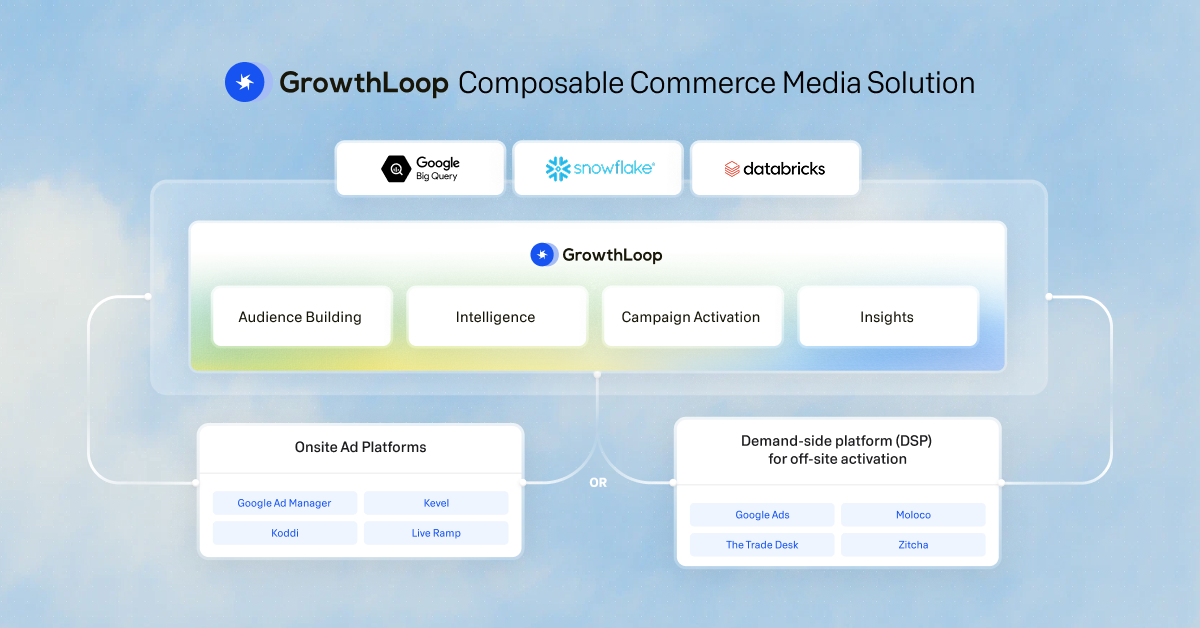
Are manual processes slowing down your RMN momentum?
With GrowthLoop’s composable commerce media solution, retail media and ad teams can build and launch precise audiences in minutes, activate across DSPs and ad platforms, and deliver transparent ROI reporting that drives advertiser revenue.
Learn how retail media leaders at Costco, Fanatics, and Gopuff use GrowthLoop to deliver stronger results for their brand partners.
The Two-Part Sales Pitch (And Why It Keeps Working)
Part one: price. By several accounts, Amazon's DSP undercuts competitors on fees—sometimes dramatically. On certain reserved deals, Amazon has reportedly charged close to zero against the fifteen-to-twenty per cent that independent platforms and Google have historically taken. Those figures come from a limited set of reports and should be read as directional rather than gospel, but the direction is the point. If two systems can buy the same inventory and one charges materially less, budget follows gravity.
Part two: data. Because Amazon is a marketplace as well as an advertising business, it holds first-party shopping and browsing data that no pure ad platform can match. Amazon knows what people search for, what they compare, what they put in their basket. Paired with cheap access to premium inventory, the pitch writes itself: buying through Amazon costs less and targets better than buying anywhere else.
So far, that argument has largely held. Amazon's ad revenue has continued to grow, and some of that growth appears to have come directly at the expense of independent buying platforms.
What This Actually Means for Sellers
- Concentration is deepening. The party increasingly positioned to route ad budgets into the newest surfaces is the same party that owns the marketplace many sellers depend on, runs the retail media those sellers already pay for, and competes with some of them directly through its own product lines. None of that is new. But each additional surface routed through Amazon's pipe makes the dependency a little deeper and a little harder to unwind.
- Measurement will decide the market. Whoever standardises how performance is counted on AI surfaces will effectively set the terms for everything built on top of them. The theoretical appeal of conversational advertising rests on the richness of intent people reveal when they talk through a decision in detail. That appeal only converts into real money if the intent signal survives the shift from organic conversation to commercially influenced one—and if it can be measured credibly. Both remain open questions.
- Watch the access threshold, not the pilot. The most practical thing for operators to track is whether AI-surface inventory eventually becomes available at lower minimums through the same console sellers already use for existing campaigns. If it does, the question stops being structural and becomes operational.
The Bottom Line
In the meantime, the smartest move is the boring one: understand the structure, watch the access thresholds, and resist the urge to treat every new deal as either a crisis or an opportunity. Sometimes it's just a pipe getting longer.
Jo Lambadjieva is founder and CEO of Amazing Wave and writes AI for Ecommerce and Amazon Sellers. This is an abridged version of a post that first ran in her newsletter on 11 September 2026, reproduced with permission. Read the full piece here.
Post-script: notes from Kiri on what this looks like from the RMN side
Jo's takeaways are pitched at SMB brands with a heavy Amazon presence. Here's how I'd translate them for enterprise brands and retailers operating an RMN.
- Could other retailers offer something similar? Nothing is stopping them, and the door has been open since May. OpenAI listed its buying routes publicly — four holdcos, plus Adobe, Criteo, Kargo, Pacvue and StackAdapt, plus a self-serve Ads Manager in beta for advertisers of any size. No partner has exclusivity. Criteo alone had over 2,000 brands running ChatGPT ads by August.
The big question is what kind of participant a retailer wants to be. Amazon is the only retailer with its own full proprietary tech stacks. All other retailer DSPs are enterprise partnerships, primary via The Trade Desk. Amazon is the only player that can make decisions like this completely on its own schedule. - Offsite has a new meaning. Off-site is a major growth story for retail media — your shopper data, activated on somebody else's premium screen. Amazon has now added a new and compelling surface, bought through a console most brand and agency media buying teams are already logged into.
When a CPG is deciding where the incremental off-site dollar goes, "we can put you inside ChatGPT" is certainly an easy button. - Amazon strengthens its USP as a DSP. Many RMNs offer retailer-specific buying interfaces or managed service as their only buying access points, and the answer from most brand teams has been that they'd rather work in one place. Every surface Amazon adds to its DSP strengthens that preference.
And finally, this news is worth keeping in proportion: this is a pilot with a handful of US advertisers, OpenAI's ad stack is still in its infancy, and pilots die all the time. Consider this another road sign on the path of both Amazon and OpenAI's ad ambitions.